Wood pergolas
Wood Pergolas: When Timber Is Genuinely the Right Choice
Nothing looks like real wood, and no honest builder pretends otherwise. But in a climate with year-round UV, endemic termites and a rainy season, timber is a commitment — so it is worth being clear about when it pays off and when a wood-look finish gets you the same result without the upkeep.
- Best suited to
- Shaded lots, older homes, and spaces where character leads
- The trade-off
- A real refinishing cycle and eventual board replacement
- Alternative
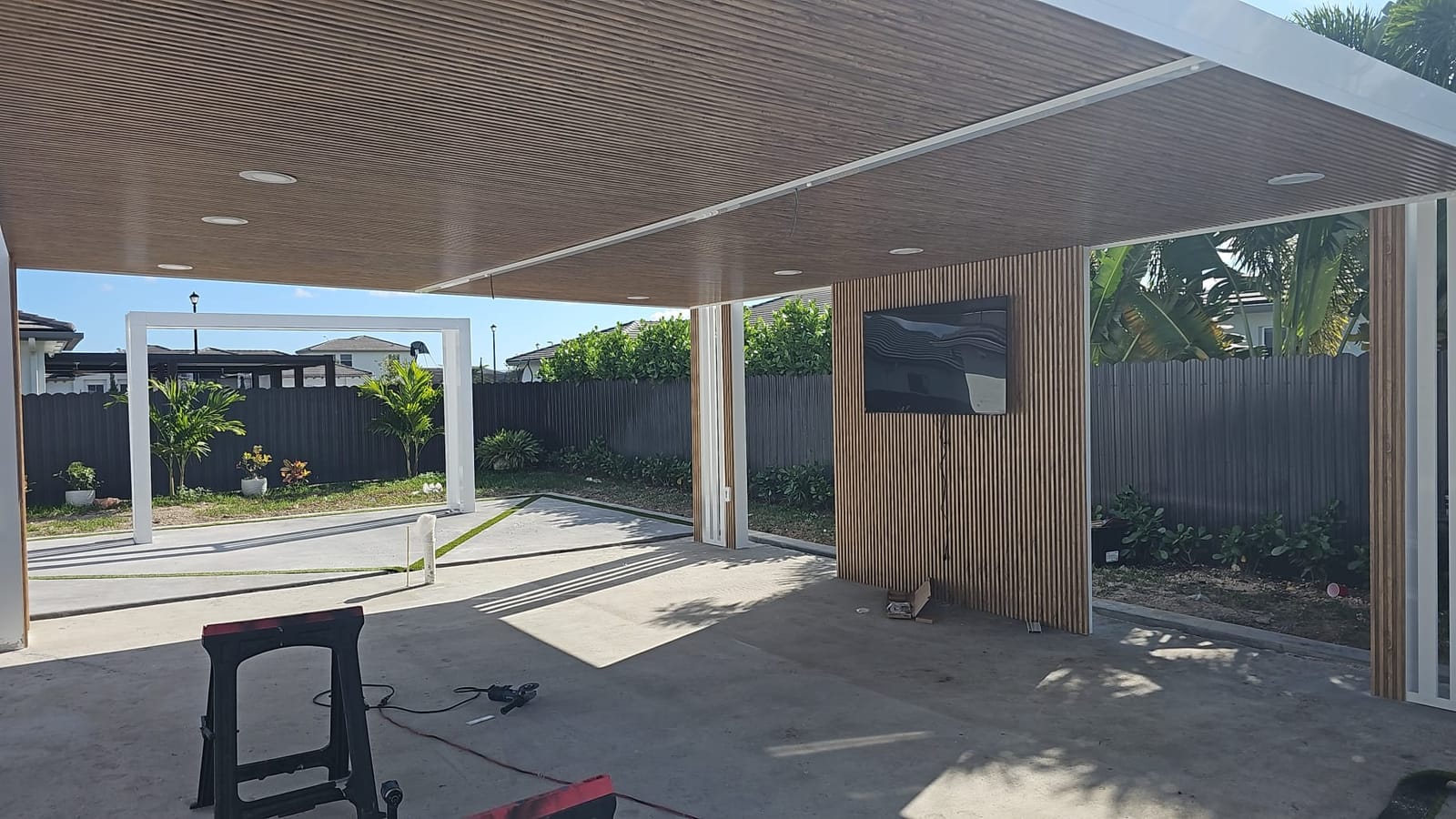
- Aluminium frame with wood-look soffit and slat panels
- Also offered
- Replacing failed timber structures
The case for timber
Real wood has a depth of grain, a colour that shifts with the light, and a softness underfoot and overhead that engineered materials approximate but never quite reach. On an older Miami house — a 1950s ranch, a Spanish-style home with timber detailing already in play — a wood pergola can be the only thing that looks like it belongs there.
Timber also performs better than its reputation suggests when the conditions are right. Under a mature tree canopy, out of the worst of the direct UV and away from salt air, a well-built and properly finished wood structure has a long and attractive life. The failures people remember are usually structures that sat in full sun, unsealed, for a decade.
What timber costs you, honestly
A wood pergola in South Florida is a maintained object, not a fitted one. Expect a real cycle: cleaning, sanding back, and re-sealing or re-staining on a schedule that depends on exposure. Expect some movement — cupping, checking, split ends at fixings — because timber responds to moisture and this is a humid place. And expect that, eventually, individual members get replaced.
Termites are the other consideration and they are not hypothetical here. Pressure treatment and correct detailing — keeping timber off the ground, ventilated, and out of standing water — slow the risk down considerably. They do not remove it.
None of that is a reason not to build in wood. It is a reason to go in knowing what you are signing up for, so the structure gets maintained instead of quietly failing.
The middle road: wood-look on an aluminium frame
A lot of people who ask for a wood pergola actually want the warmth of wood rather than the timber itself. If that describes you, the strongest option is usually a powder-coated aluminium frame carrying wood-look composite soffit and slat panels: the grain and tone overhead where you see it most, and a structure that does not rot, warp, feed termites or need refinishing.
Several of the structures in our gallery are built exactly this way — a graphite aluminium frame with a warm timber-toned ceiling. In photographs, and standing under them, they read as wood.
Replacing a timber pergola that has failed
If you already have a wood structure that has gone — soft posts at the base, split beams, a roof that never really shed water — replacement is straightforward work and a good moment to reconsider the material. We will tell you honestly whether what you have is repairable or whether you are better off starting again.
How to decide
Three questions usually settle it:
- How exposed is the spot? Full sun all day, or near open water, pushes hard toward aluminium. Deep shade under mature trees opens the door to timber.
- Will it actually get maintained? If the honest answer is that nobody is going to sand and re-seal a pergola every few years, choose the material that does not need it.
- Do you want wood, or the look of wood? If it is the look, a wood-look soffit gets you most of the way for a fraction of the long-term cost.
Tell us which way you are leaning and why, and you will get a straight recommendation — including when that recommendation is not to build in timber.
Ask about a timber build
Mention the exposure and the look you are after.
Wood, aluminium, or something in between?
Send a photo of the spot and the house it sits against. Material is easier to advise on than most people expect once you can see the context.